

Armenian or Safavid: a reconsideration of the architecture and decoration of the Vank Cathedral in Isfahan, 1664-1074
Awardee: Ahmad Yengimolki
Year: 2021
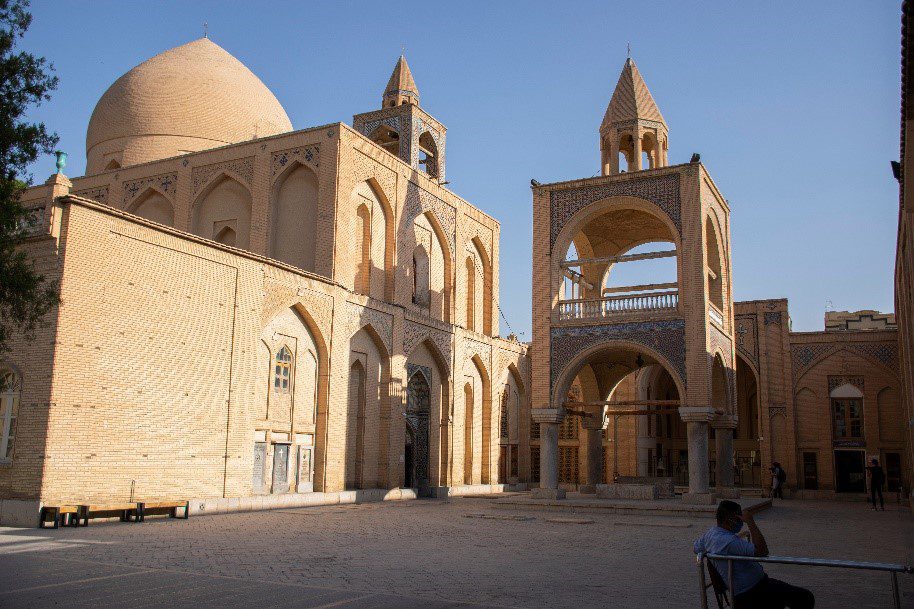
In some works of art, the relationship between religions goes beyond the realm of dialogue, going so far as to form references relevant to both. One of the best examples of this is seen in the architecture of Vank Cathedral (Surb Amenaprkič) in Isfahan (1655-1664/1065-1074). During the migration of 1604/1012, hundreds of Armenian clerics abandoned their monasteries and churches and move to Iran with the other deportees. Thus, from the first years of relocation, a campaign of church building began in New Julfa.
Within this context, Vank Cathedral, in its construction, exhibits both Safavid and Armenian architectural and artistic features. Despite this, Robert Hillenbrand has argued that apart from the purely cosmetic change brought about by the employment of these local materials, it remains entirely Armenian. Nevertheless, Loosely’s has argued that the changes in this building are the result of Shah ‘Abbas’ decision that churches should fit within the local Isfahani architectural setting.
The interior also exhibits a combination of Armenian painting and Safavid-Islamic geometric ornament. As far as the style of the murals is concerned, it seems, based on the evidence of the few murals and a large number of surviving manuscript miniatures, that there are significant differences when compared to the tradition of Armenian painting traditional before the migration. One of the most important of these is the tendency to paint realistically using perspectival depth, shadowing, and the use of landscapes and buildings in the background. Thus On one hand, some scholars, such as Eftekharian-Laporte, see them as the immediate result of encountering Western painting styles. On the other hand, due to the anonymity of the artists working on the paintings, scholars such as Carswell have considered them to be the work of Western artists presuming that Armenian painters did not have the skill to paint in a realistic style. The main questions of this research, therefore, are as follows:
- To what extent has Vank Cathedral used the Safavid architectural tradition in its construction?
- What are the reasons for the changes in the construction of Armenian churches compared to those characterizing pre-immigration examples?
- Is the change in the style of painting in the churches of Isfahan, especially Vank Cathedral, due solely to the influence of the Western art?
- How was the decoration intended to move the individual worshipper around the space; how does it sacralize the space?
About the awardee
Ahmad Yengimolki is PhD candidate in the History of Art Department at the University of York where he works on a reevaluation of the Vank Cathedral in Isfahan in the context of Safavid art.