October 2022 | BIPS Student Travel Grant
Royal Women, Armies and Warfare in Hellenistic Iran: who had more Power?
Report:
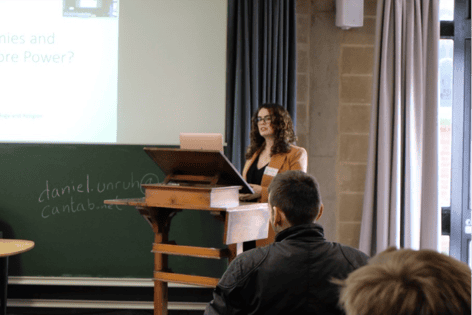
The British Institute of Persian Studies (BIPS) Travel Grant was used to fund my attendance to the Classical Association (CA) Annual Conference (21st – 23rd April 2023), hosted by the University of Cambridge, where I delivered a paper entitled ‘Royal Women, Armies and Warfare in Hellenistic Iran: who had more Power?’.
My paper aimed to revaluate and challenge the traditional concepts associated with the idea of power to showcase how they hinder our comprehension of past societies, especially minorities, focusing on the case of Achaemenid and Seleucid royal women. This paper argued that the preconceived vision of power is still attached to the concept of ‘hard power’ (ownership of armies, wealth, weapons, etc. used as a coercive tool towards other individuals and peoples), an interpretation that relies on ideals of masculinity and performance in battle that miss numerous dimensions of power, leadership, and agency.
The paper started by discussing the importance of the methodology we use in our analysis, and how building our discussion around hard power disregards other important indicators of whether someone had power or not. The rest of the paper was structured as a comparison between specific royal women from the Achaemenid and Seleucid dynasties, establishing a connection between them to show the different ways in which power can present itself. Overall, the two key arguments were that power comes in many forms, as does the intervention and interaction of royal women with ancient warfare; and second, that royal women from the Hellenistic period were influenced by their predecessors, not only those from Greek or Macedonian heritage, but by the Iranian women that came before them too.
The CA Conference was the perfect environment to present part of the research from my thesis, which focuses on Achaemenid royal women, soft power, and leadership, as well as the results of further study on these topics during the Hellenistic period that I have carried out. This paper was well received by those attending, the feedback was excellent and there was a visible interest in its thesis and arguments. The subsequent discussion encouraged me to pursue this topic further, as the comments supported my claims and enjoyed seeing this new perspective of women’s power in antiquity. Attending this conference allowed me to insist on the importance of Achaemenid women in a period that, due to the insertion of Hellenic culture and royalty, tends to dim the light of what was already there, the past of already great lands and cultures, promoting the crucial permanence of Iran’s own heritage and history.
Thanks to the generosity of the BIPS Travel Grant I was able to present my research to a wide range of members of the academic community at the University of Cambridge during the 120 anniversary of the Classical Association. This grant also allowed me to engage in fruitful discussions and to network with publishers and researchers from other universities, leading to future collaborations and publications. Therefore, the support of the British Institute of Persian Studies has contributed not only to my current work as a PhD candidate, but to the future of my research output and projects, as well as to the improvement of crucial skills for my training such as public speaking. Furthermore, the new colleagues I was able to meet and network with will certainly shape my future as a scholar, and I am grateful for the opportunity that this Travel Grant and the British Institute of Persian Studies have awarded me with (image credit CA 2023 Photographer).